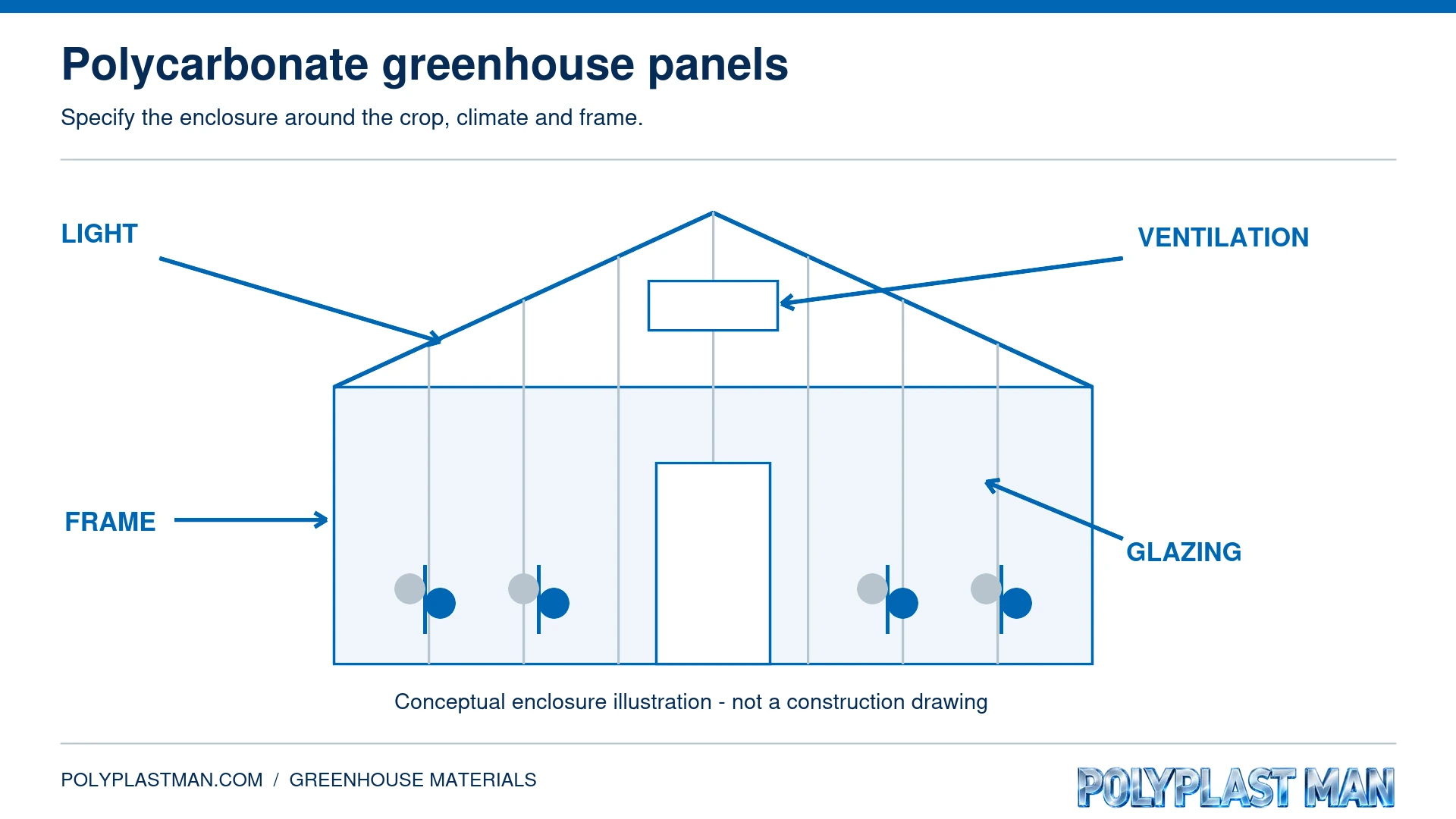
thermoplastic known for very high impact resistance; widely used for roofing, glazing and skylights.">Polycarbonate greenhouse panels influence much more than the appearance of a growing structure. They help determine how daylight reaches the crop, how quickly heat escapes and what maintenance the enclosure will need. For a grower comparing quotations, the useful question is not simply which sheet is strongest. It is which glazing system suits the crop, climate and supporting frame.
A nursery raising young plants may value controllable light and reliable enclosure details. A heated vegetable greenhouse may put more weight on thermal performance. A small seasonal growing house may need a simpler, affordable covering. These are different briefs, even when suppliers use the same word, “polycarbonate,” for all three.
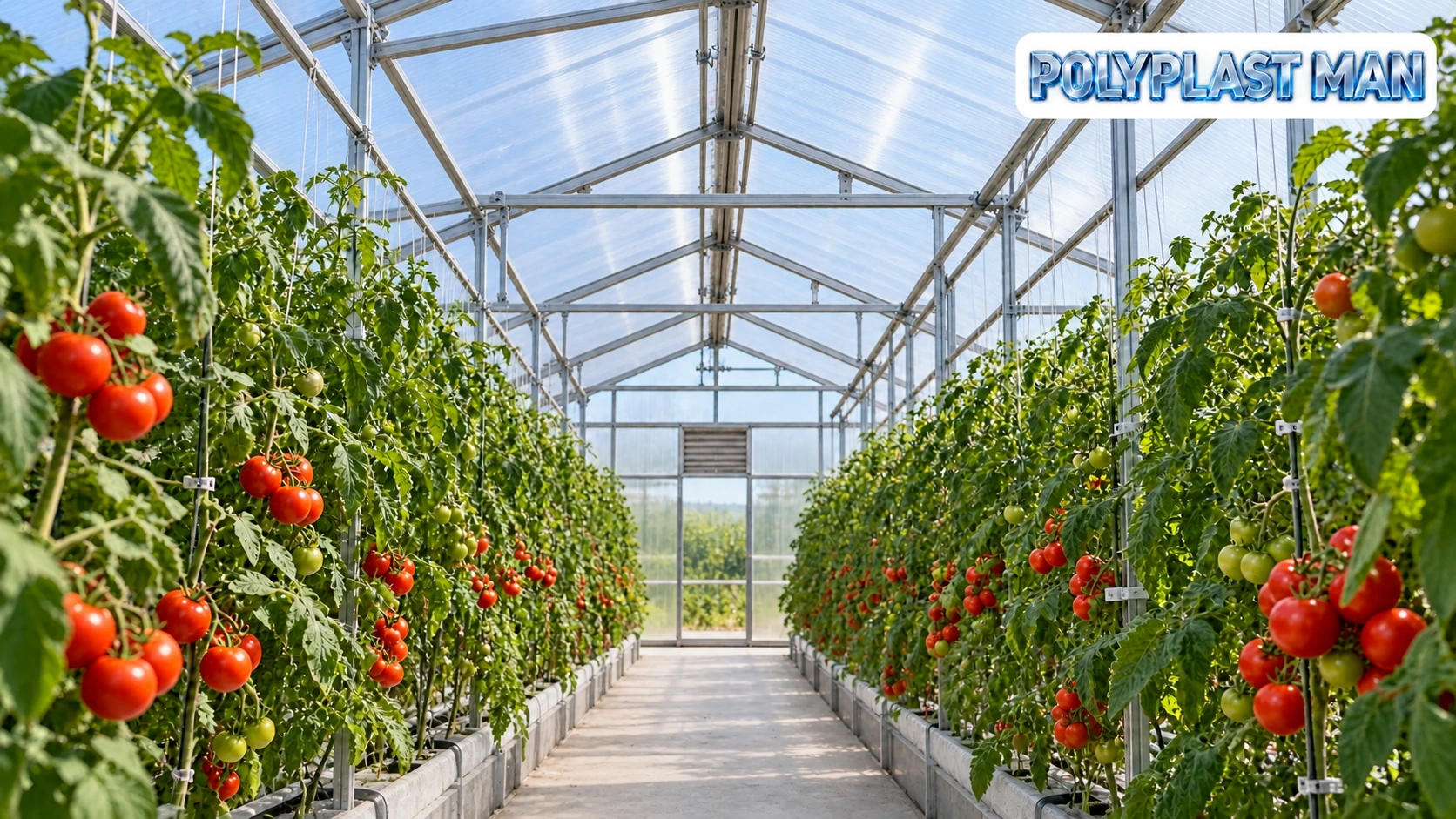
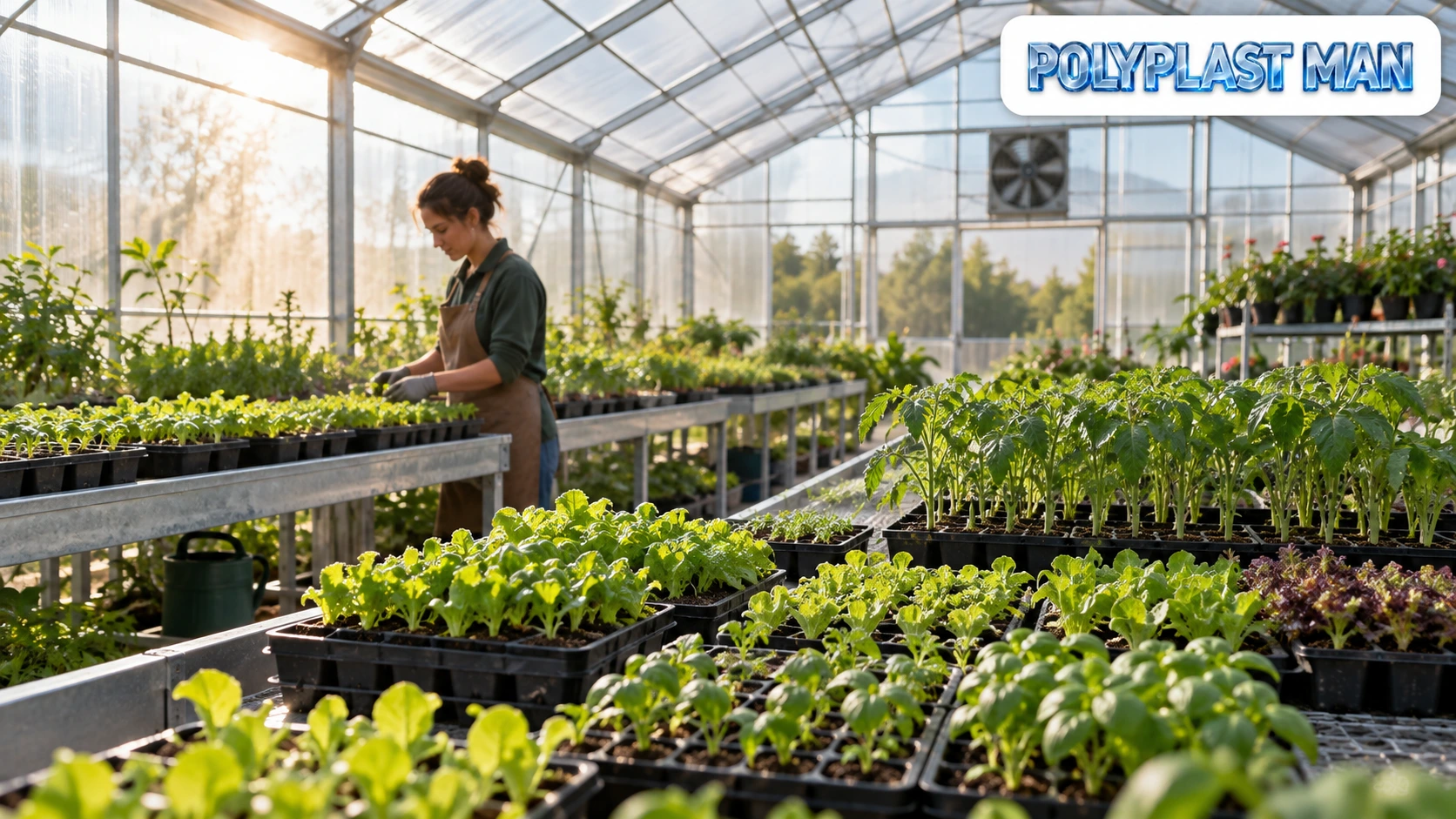
This article explains the material choices and the questions worth asking before purchase. Technical values should come from the selected product’s current documentation; a specification for one panel must not be assumed to apply to another. The charts are explanatory diagrams. The photo-style images are AI-generated illustrations, not photographs of named projects or measured performance tests.
What are polycarbonate greenhouse panels?
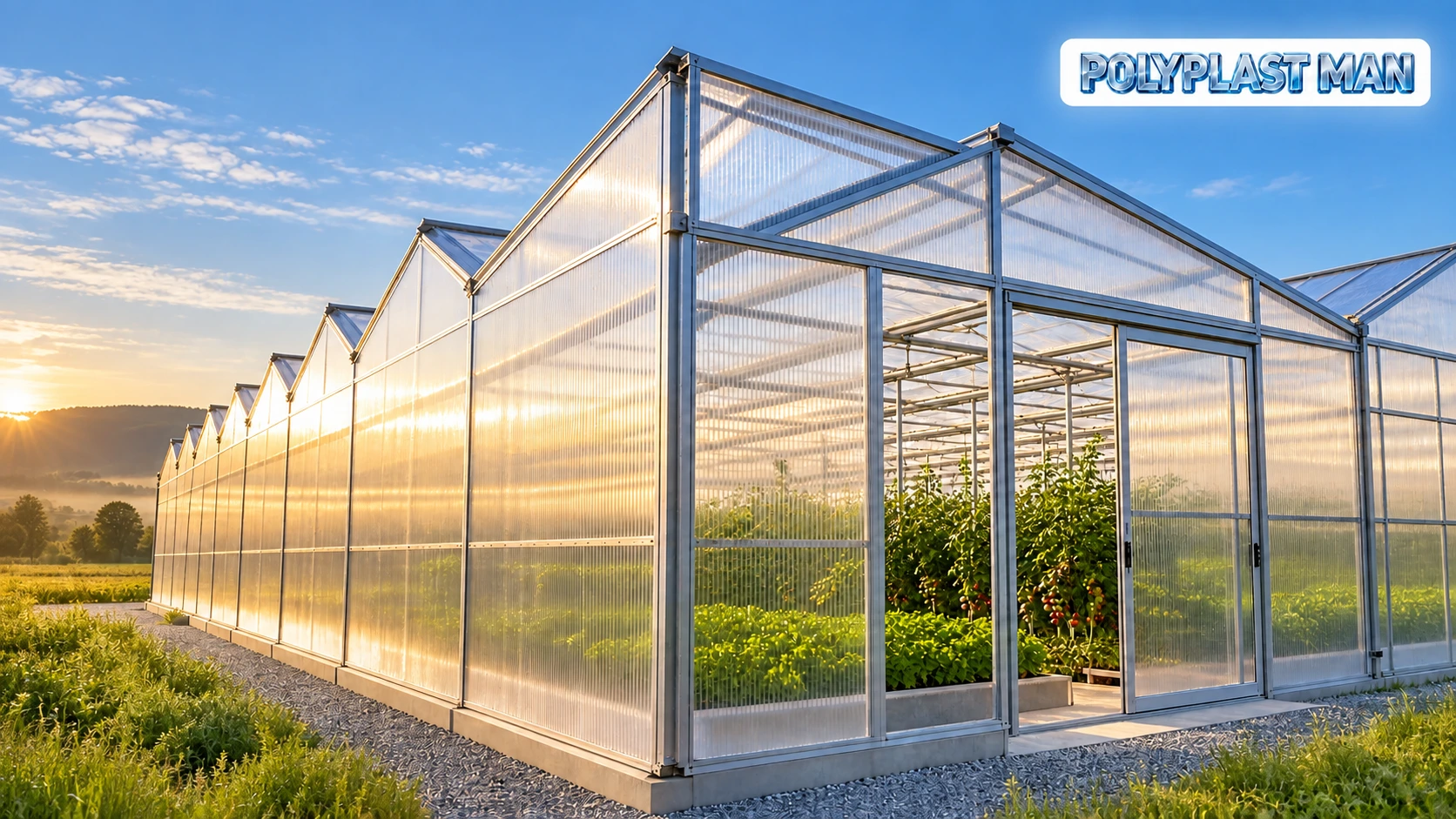
They are rigid or semi-rigid thermoplastic sheets used to enclose greenhouse roofs, walls and end sections. Clear and translucent grades admit daylight while forming a weather barrier. Unlike flexible greenhouse film, the panels usually depend on a compatible system of supports, profiles, fixings and edge details.
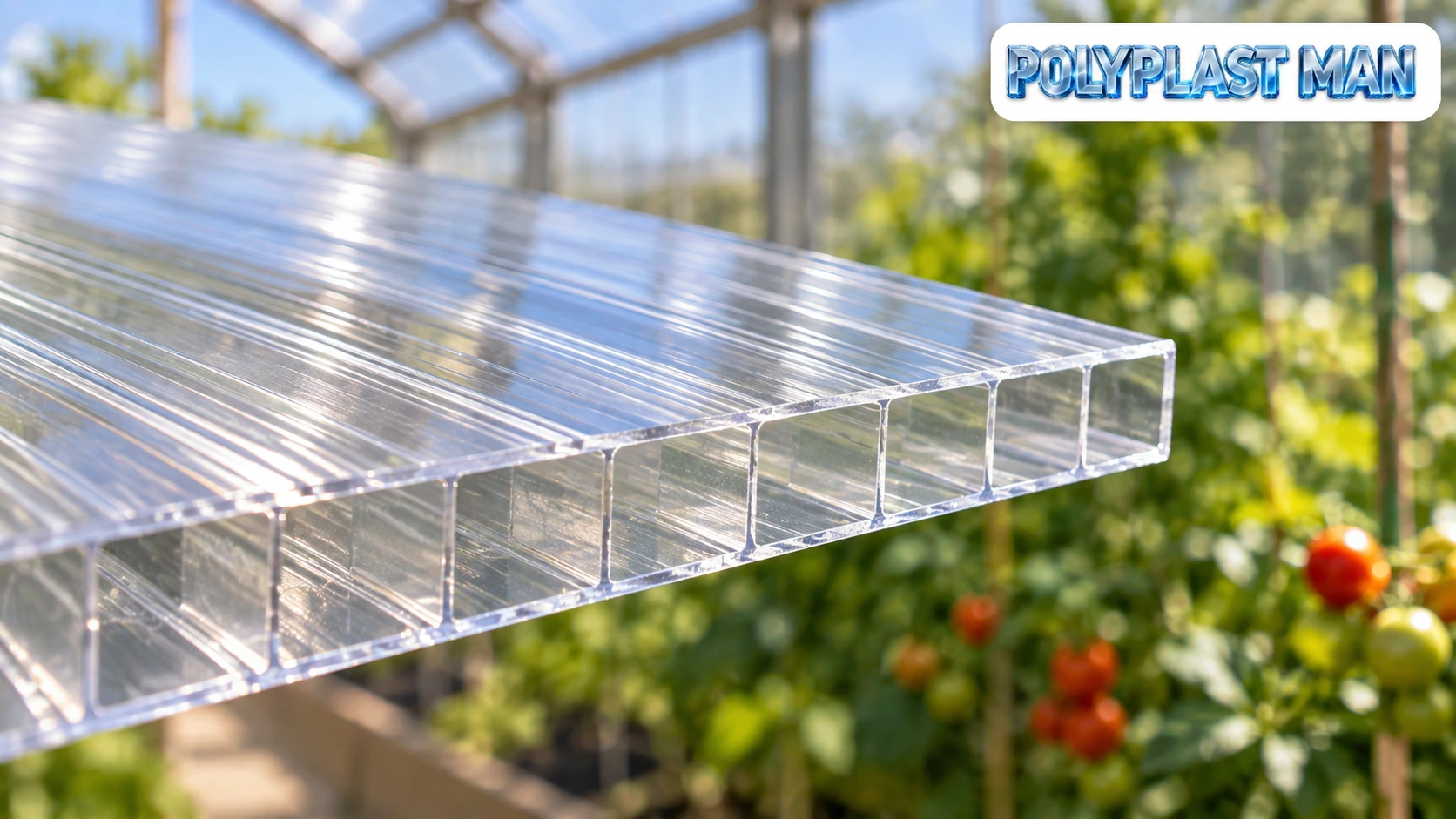
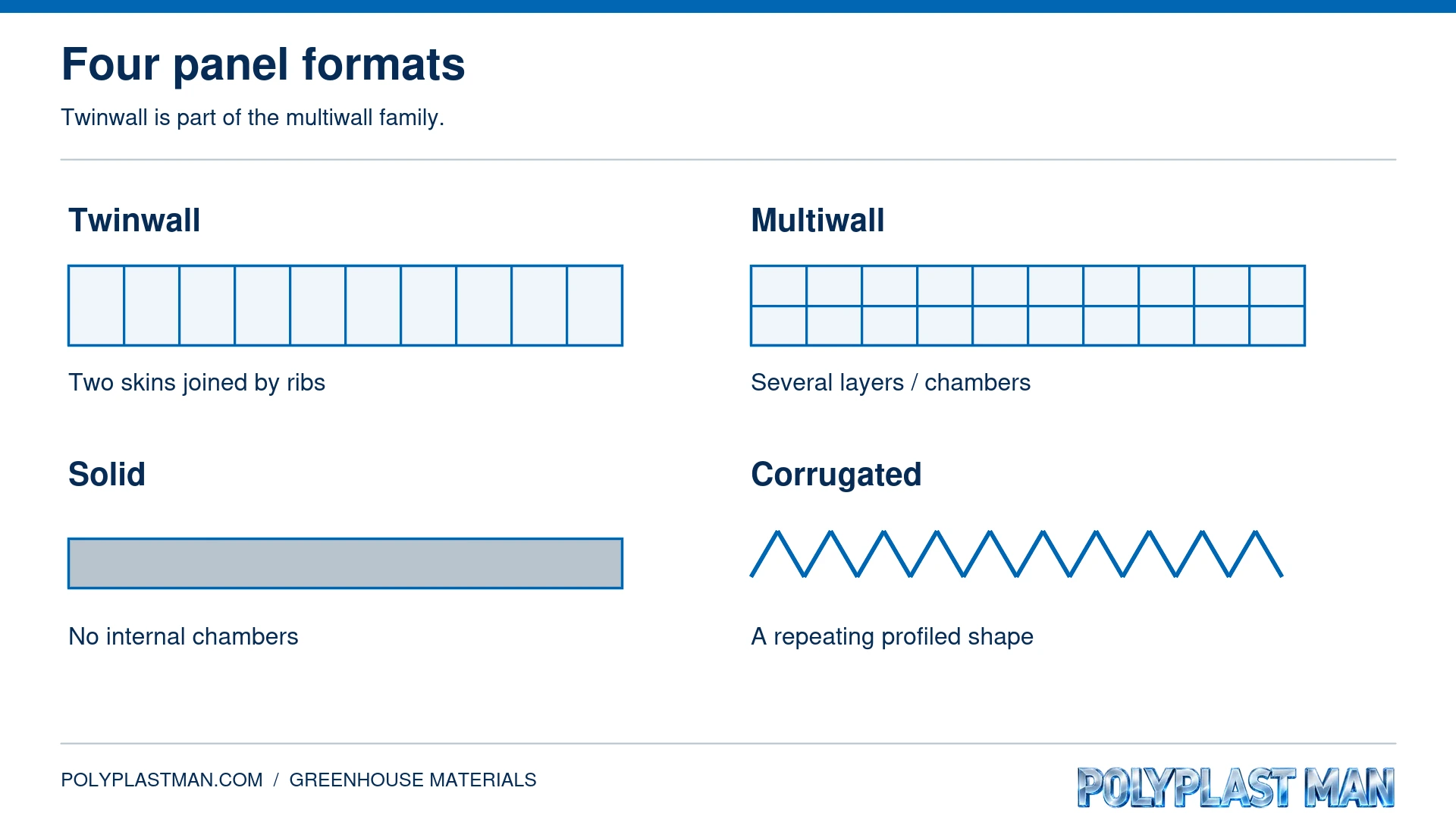
The material is supplied in several constructions. A solid sheet contains no internal chambers. A multiwall sheet has thin skins separated by ribs, creating air spaces within the panel. Twinwall is a member of the multiwall family, not a separate polymer. Corrugated sheets gain their profile from a repeating wave or angular shape.
Those differences matter in use. Two products described as transparent polycarbonate can behave differently in heat transfer, light distribution and allowable span. A useful quotation therefore identifies the exact grade and construction, rather than just the material name. Oklahoma State University’s greenhouse covering overview provides background on the wider choice of glazing materials.
Types of polycarbonate greenhouse panels
Multiwall: cavities within the sheet
Multiwall panels use internal chambers to provide a different thermal construction from a single solid skin. Products can have several layers and different rib arrangements. They are worth investigating where the enclosure must balance daylight with heat retention, particularly for a greenhouse that operates through cool weather.
More internal structure also changes the optical path through the panel. Do not assume that the thickest or most complex sheet gives the best crop environment. Compare its light data, thermal data and support requirements together.
Twinwall: the simplest chambered format
Twinwall normally describes two skins joined by ribs. Its relative simplicity can make it a practical option for garden greenhouses, nurseries and other structures where the specified panel meets the project requirements. The open ends of its channels require suitable protection.
A buyer should distinguish nominal thickness from the full product specification. Rib geometry, sheet mass, tolerances and approved spans still matter. Matching thickness labels alone is not a reliable way to establish equivalence between suppliers.
Solid: an uninterrupted sheet
Solid polycarbonate can provide a clearer view through the enclosure than a visibly ribbed panel. That may be useful for doors, observation areas or particular wall sections. It does not contain the insulating air spaces of a chambered sheet.
Consider solid glazing as a design option with its own support and thermal requirements. Choosing it simply because it looks more like glass can overlook the operating needs of the growing space.
Corrugated: a profiled covering
Corrugated polycarbonate can suit greenhouse roofing or wall applications when its profile and fixing system are compatible with the structure. A single-skin corrugated panel should not be treated as thermally equivalent to multiwall glazing.
The profile dimensions matter during repairs and extensions. Sheets that look similar in a catalogue may not overlap correctly. Confirm the actual profile, effective covering width and matching accessories before ordering.
Where the material helps, and what to check
Daylight that serves the crop
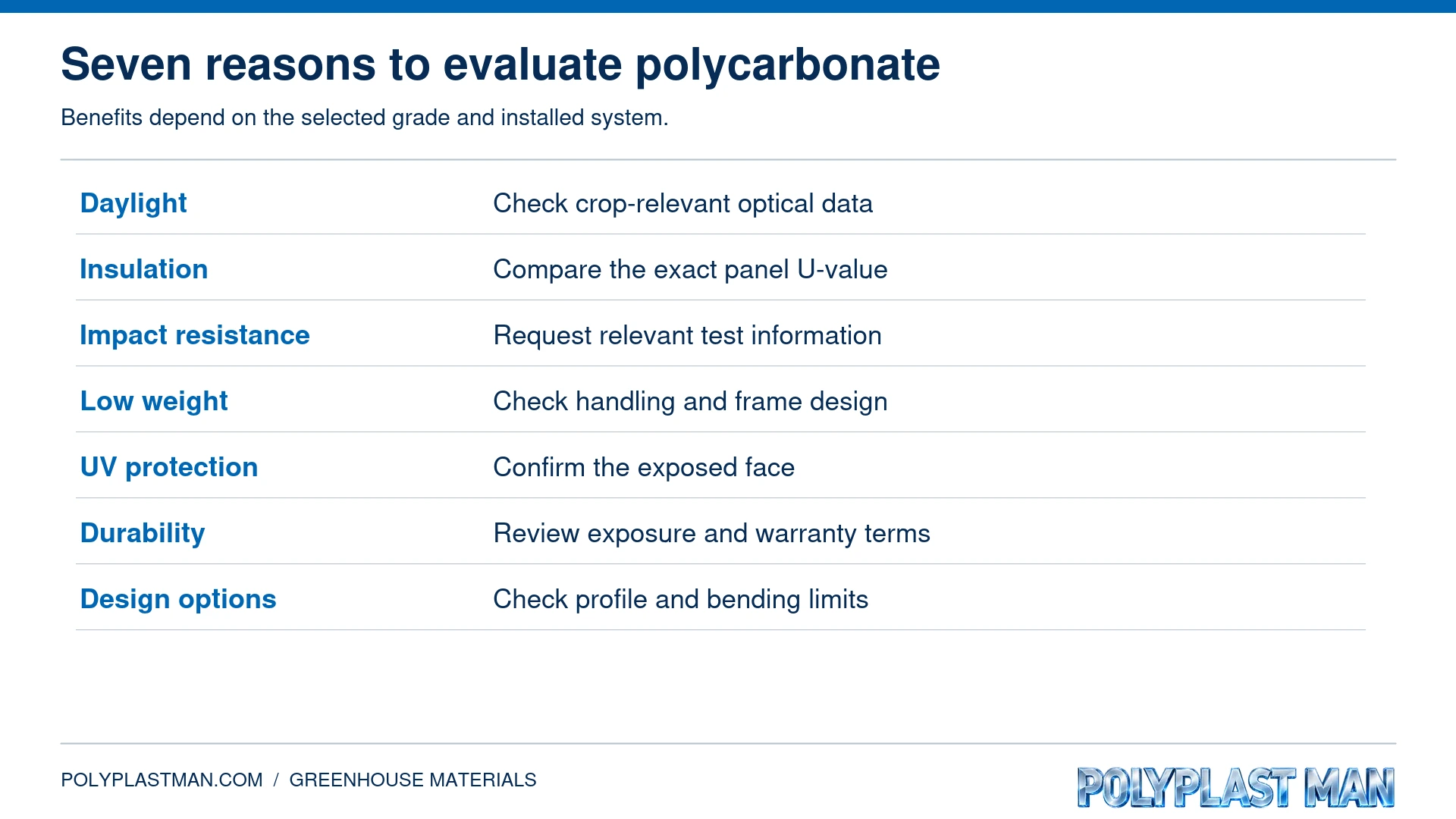
Transparency is useful only if enough suitable light reaches the plants. Panel colour, diffusion, framing, shading equipment and dirt all affect that outcome. A glazing sample held up to the sky tells less than a product data sheet combined with the greenhouse design.
Insulation for the intended operating season
Chambered panels can offer an insulation advantage over single-layer glazing. That matters most when the grower needs to retain heat. It does not eliminate losses through gaps, doors, vents or other parts of the building. Ask for the U-value of the exact construction, with its units and test conditions.
Resistance to impact
Polycarbonate is valued for its toughness compared with brittle glazing. This can be useful where handling damage or impact is a concern. It is not a promise that a greenhouse will survive every hailstorm, wind event or falling object. Performance belongs to the tested panel and installed assembly.
Handling and structural weight
Relatively light sheets can simplify movement around a site compared with heavy glazing. Large panels still need controlled handling, especially in wind. Reduced cladding weight does not remove the need for engineered supports and anchorage.
UV protection for outdoor exposure
Specify a product intended for external use and check how its UV protection is provided. Surface orientation may be critical. “UV protected” is not a complete description of the light spectrum transmitted to the crop.
Durability that depends on the details
Outdoor performance depends on product quality, exposure, installation and maintenance. Ask what the warranty actually covers and what installation records are required. A warranty period is not an unconditional service-life prediction.
Options for different greenhouse designs
Different formats allow designers to consider flat roofs, walls and approved curved applications. Any cold bending must remain within the selected manufacturer’s limits. Flexibility is useful when it is planned into the specification, rather than forced into the sheet on site.
Read light specifications with the crop in mind
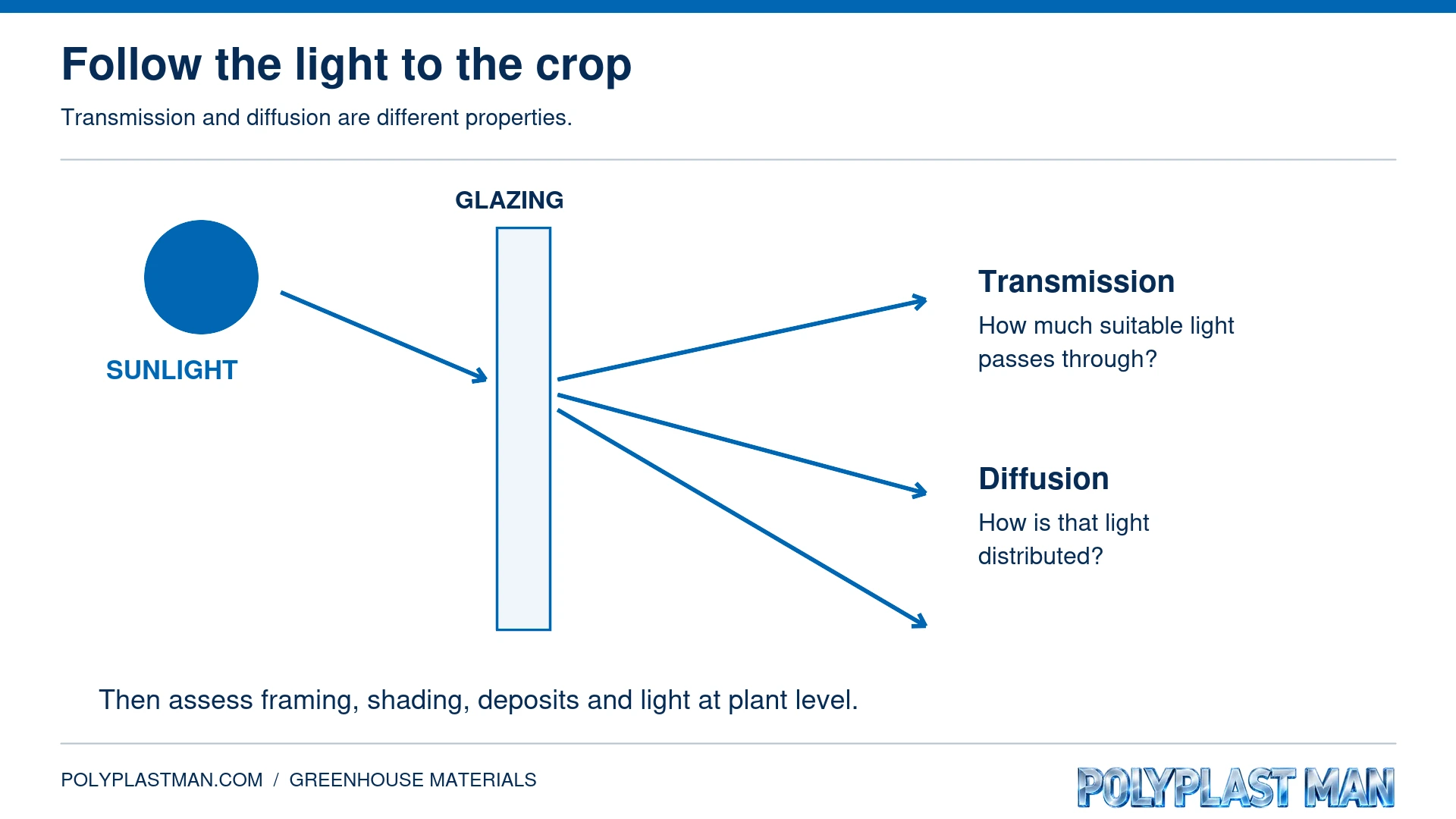
Visible light transmission describes light in terms relevant to human vision. Crop assessment may instead require photosynthetically active radiation information and daily light integral, or DLI. DLI describes the photosynthetic light received over a day; it is not the same as how bright the greenhouse looks at noon.
Michigan State University’s greenhouse lighting guidance discusses the relationship between light availability and production. For a new project, ask an agronomist or greenhouse designer which measurements are relevant to the planned crop and season.
Diffusion is another separate property. Scattering incoming light can change its distribution through the plant canopy, but “diffuse” should not be treated as a guaranteed yield increase. Compare transmission and diffusion together. A strongly diffusing panel that admits too little light may not suit a light-limited crop.
For example, a nursery and a fruiting vegetable operation need not select the same glazing. The decision should include crop requirements, local sunlight and the planned shading strategy. Decorative bronze or dark roofing colours should not be chosen for a greenhouse without checking the horticultural consequences.
Thermal performance is a whole-greenhouse question
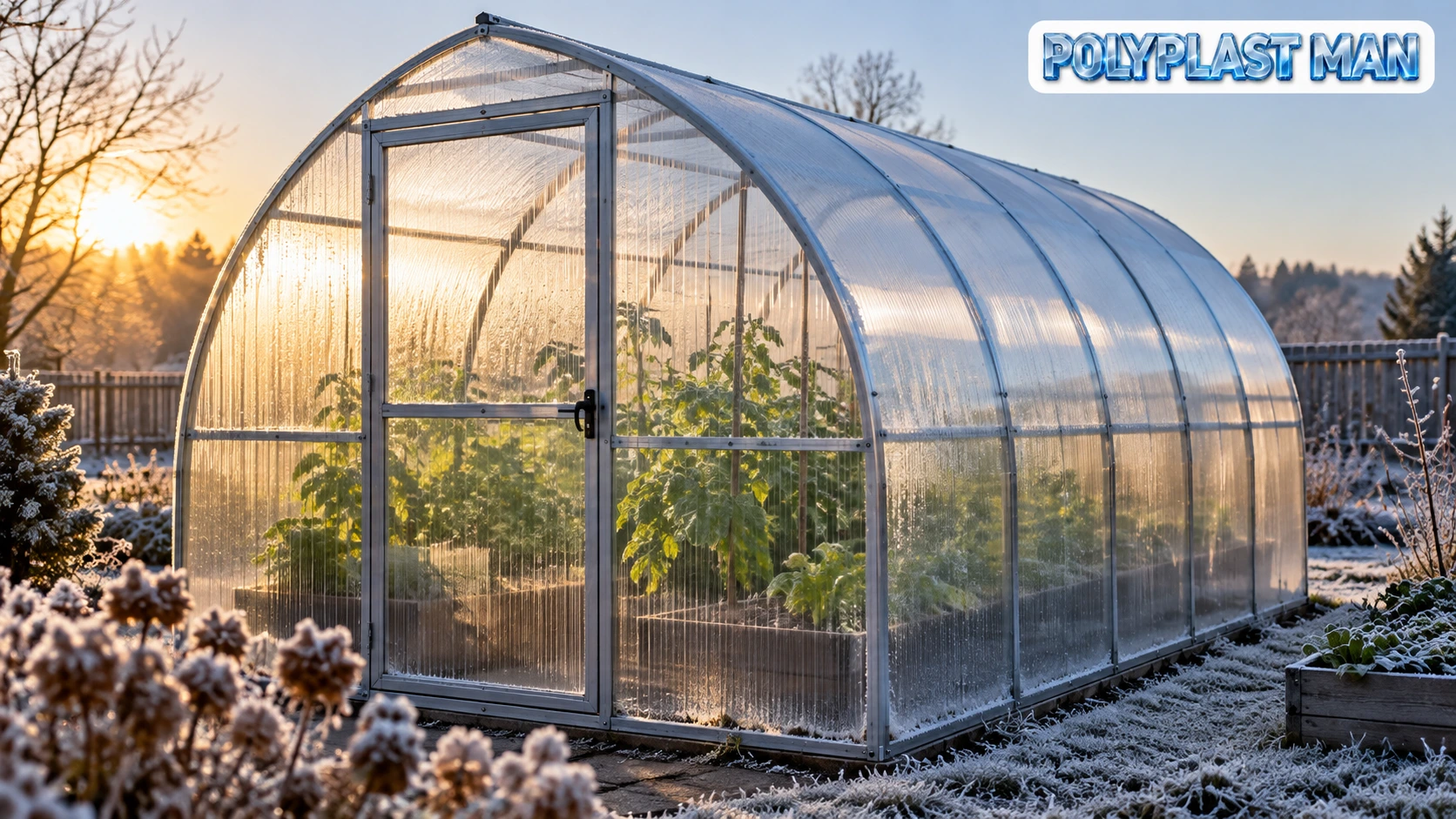
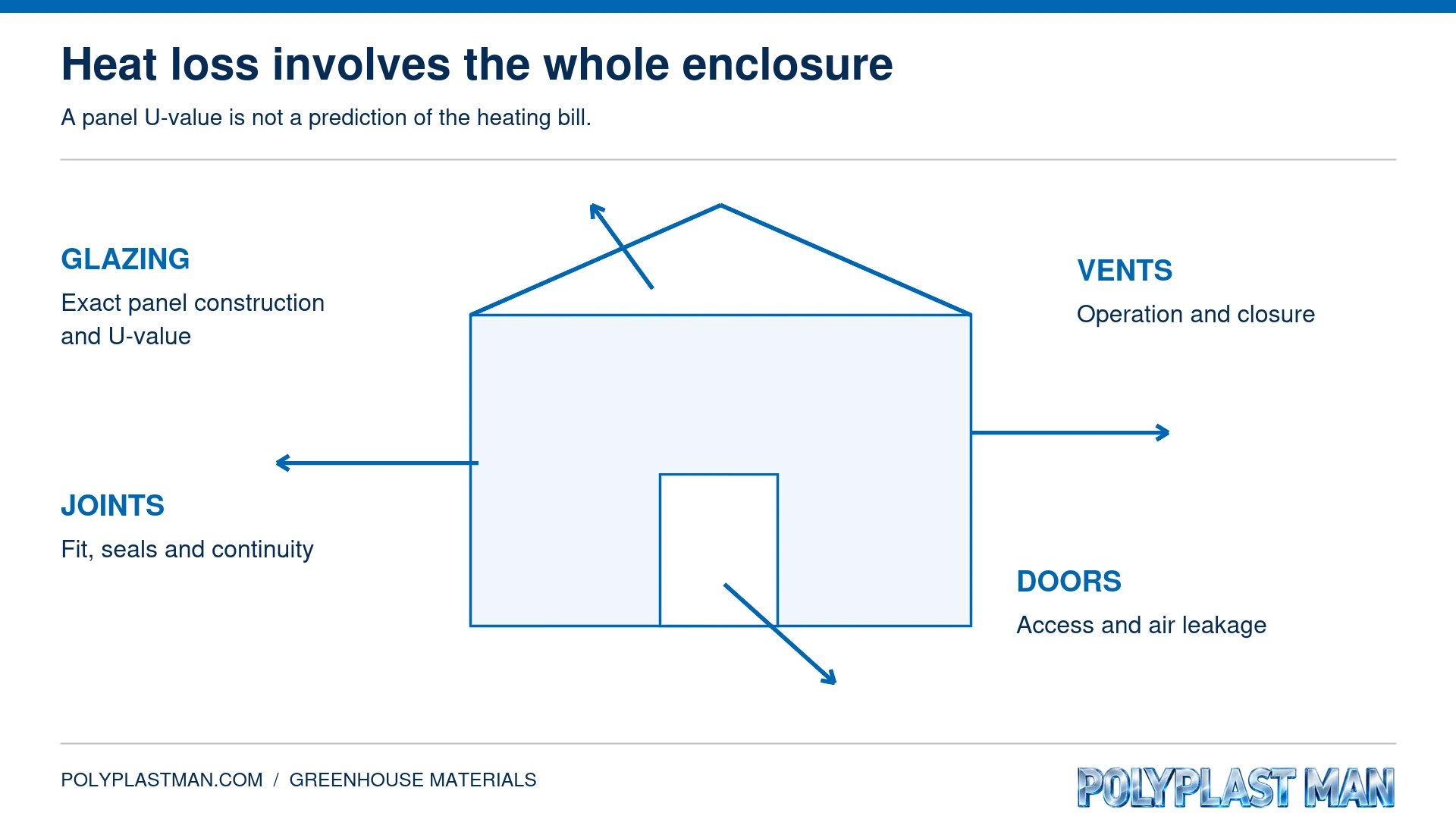
A lower U-value indicates less heat transfer through a construction under the stated conditions. That makes U-value useful for comparing otherwise suitable panels. It does not, by itself, predict the greenhouse’s heating bill.
Imagine two houses fitted with the same roof sheet. One has poorly closing vents and gaps around doors; the other has carefully fitted joints and a managed thermal screen. Their operating results can differ even though the panel specification is identical. This is why a savings percentage without a defined baseline is a poor purchasing guide.
In warm conditions, retaining heat may not be the priority. Ventilation, shading and cooling need to be designed alongside the glazing. Insulation does not actively cool the greenhouse, and a transparent enclosure can still overheat.
Ask the project team to assess both the coldest operating conditions and the warmest growing periods. A specification based on a single season may create avoidable problems during the rest of the year. UMass Extension’s greenhouse energy guidance is useful background for treating the enclosure and environmental systems together.
Polycarbonate versus glass: compare the assemblies
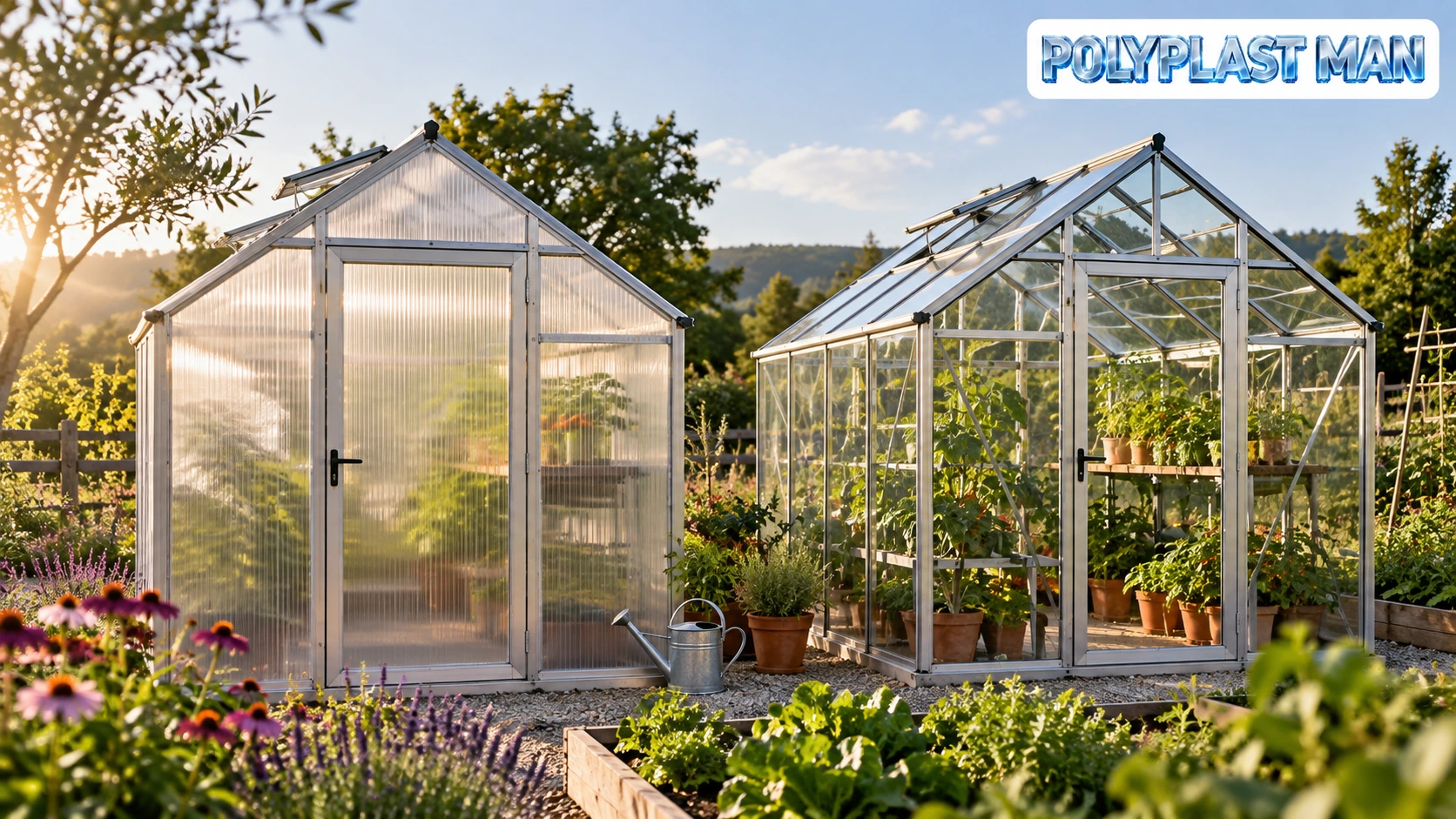
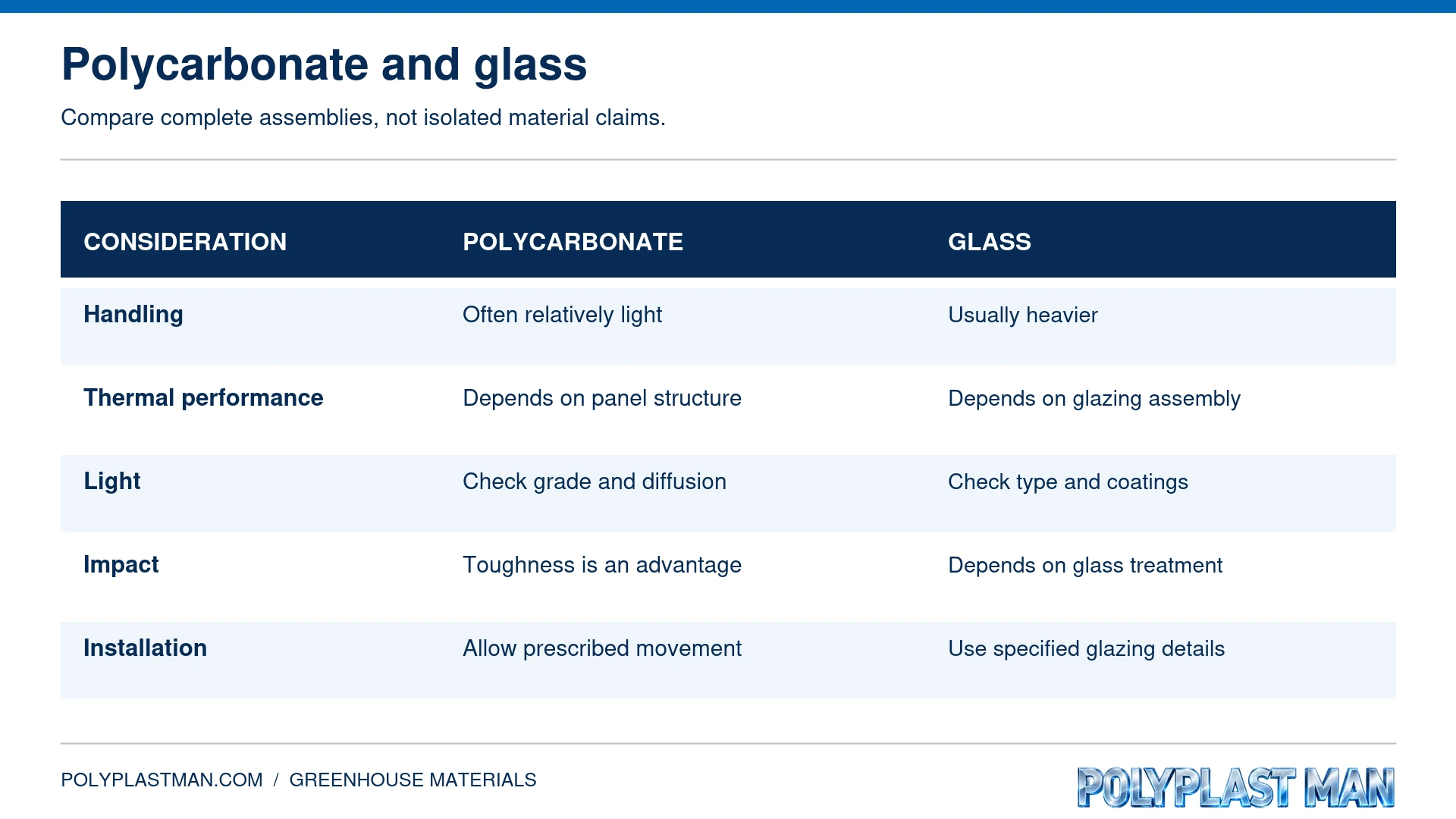
Neither material is universally better. Glass type, coatings, pane construction and support details matter, just as panel structure and UV protection matter for polycarbonate. This table is qualitative; it does not assign invented performance scores.
| Feature | Polycarbonate panels | Glass glazing |
|---|---|---|
| Weight and handling | Often lighter; large sheets still need careful handling. | Generally heavier; lifting and breakage planning are important. |
| Impact | Toughness is a material advantage; verify product ratings. | Behaviour depends on glass type and treatment. |
| Insulation | Multiwall chambers affect thermal performance. | Single and insulated glass constructions differ substantially. |
| Light | Varies with structure, colour and diffusion treatment. | Varies with composition, texture, coatings and construction. |
| Installation | Needs compatible profiles and thermal movement allowance. | Needs appropriate glazing supports and retention details. |
| Cleaning | Avoid abrasive or chemically incompatible products. | Coatings and seals also require suitable cleaning methods. |
| Design flexibility | Some grades permit controlled cold bending. | Curved forms generally require purpose-made glazing. |
| Applications | Consider for nurseries, commercial and garden structures. | Consider where the engineered glazing system suits the project. |
Request comparable whole-system quotations. A sheet-only price beside a fully installed glass price is not a useful comparison. Include structural alterations, glazing bars, ventilation integration, delivery, access and replacement arrangements.
How to choose the right panels

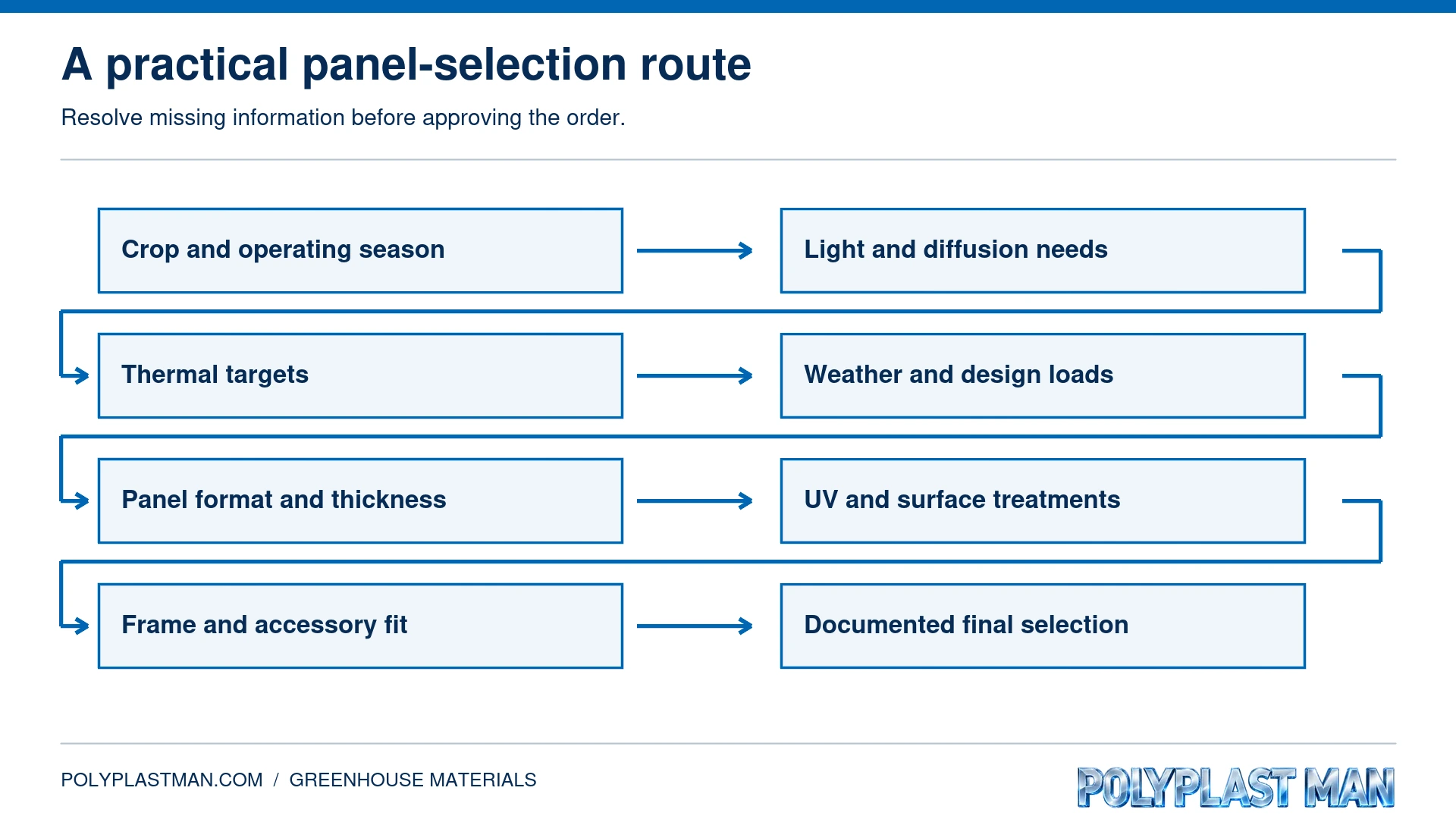
Start with an operating brief
Write down the crop, growing season, target environmental conditions and whether the house will be heated. Include planned changes in use. This gives suppliers something concrete to respond to and helps prevent a standard roofing product being offered without an agricultural assessment.
Specify structure and thickness together
There is no universal greenhouse thickness. Select it with the panel format, support spacing, local design loads and thermal requirements. A thickness that works on one frame may be unsuitable on another. Ask for the manufacturer’s span information and have the designer check its assumptions.
Check the full optical specification
Ask which transmission measurement is quoted, whether it applies to the exact colour and thickness, and whether a diffusion value is available. If the supplier offers several grades, request their data side by side. “Clear” on the invoice is not enough to document the intended optical performance.
Confirm UV protection and surface treatments
Record which face goes outdoors and whether a separate anti-condensation surface must face inward. Not every panel has both treatments. The delivery markings and installation instructions should agree with the quotation.
Fit the panel to the frame
Check usable covering dimensions, profiles, edge engagement and the arrangement around vents, doors and gutters. Include thermal movement allowances in the cutting schedule. Buying the sheets first and solving joint details later can lead to waste or unsuitable compromises.
Assess local exposure
Consider wind, rain, hail, snow where relevant, temperature variation and surrounding hazards. A sheltered nursery and an exposed farm site can need different detailing. Use applicable structural requirements and documented product performance rather than broad regional assumptions.
Before approving the order, ask the supplier to identify any requirement the proposed system does not meet. A clear limitation is more useful than an unqualified statement that a panel is suitable for every climate.
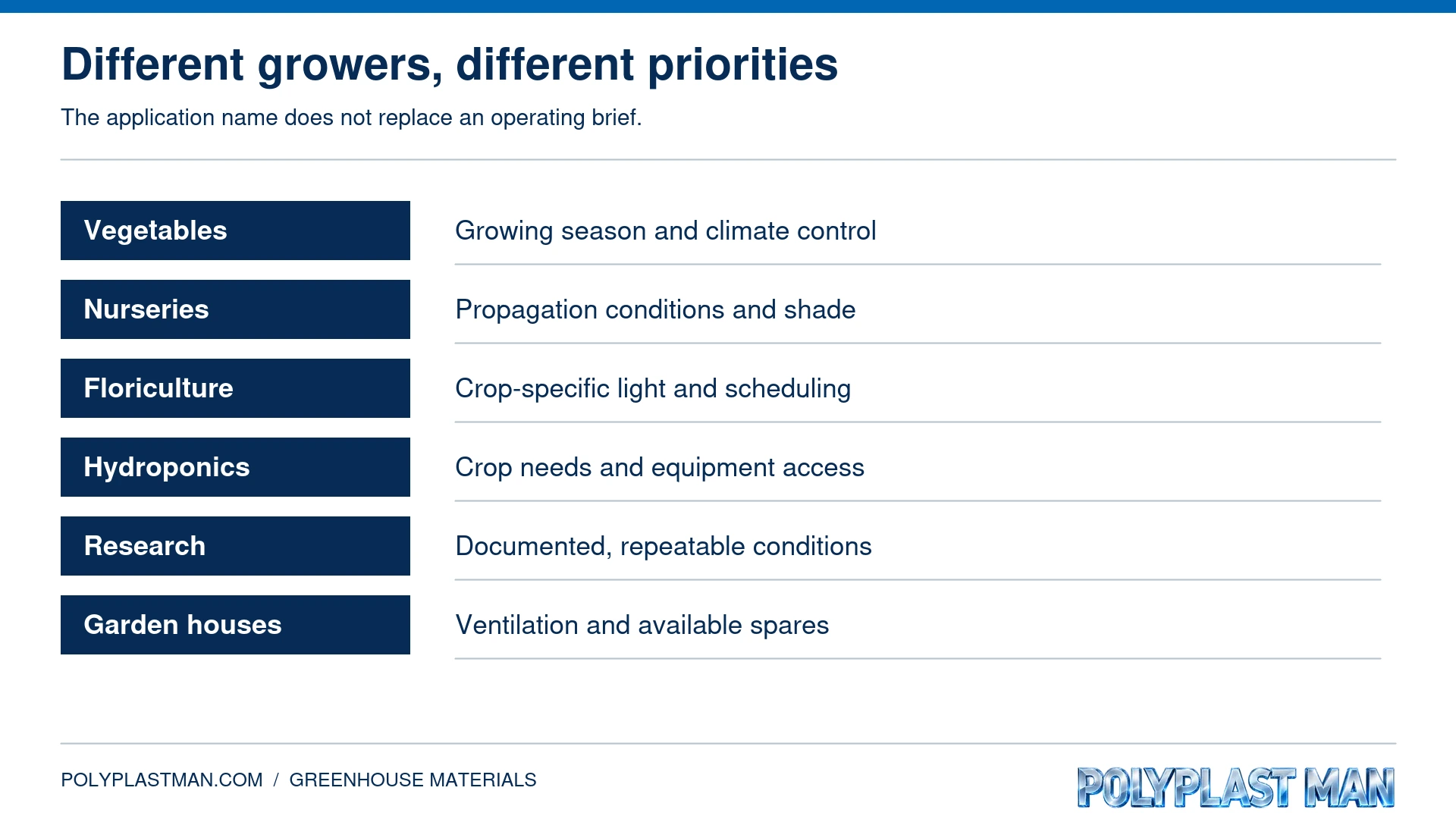
Applications and different operating priorities
Commercial vegetable production: assess the growing environment across the production calendar. Glazing selection should sit alongside ventilation, irrigation, crop support and access planning. The enclosure cannot compensate for missing environmental control.
Nurseries and propagation: focus on consistent growing conditions and the ability to manage light. Bench position, shading and irrigation practices belong in the same discussion as the roof panel.
Floriculture: crop scheduling and quality requirements can make control of light especially relevant. The grower should specify the intended species and production stages rather than rely on a general “flower greenhouse” description.
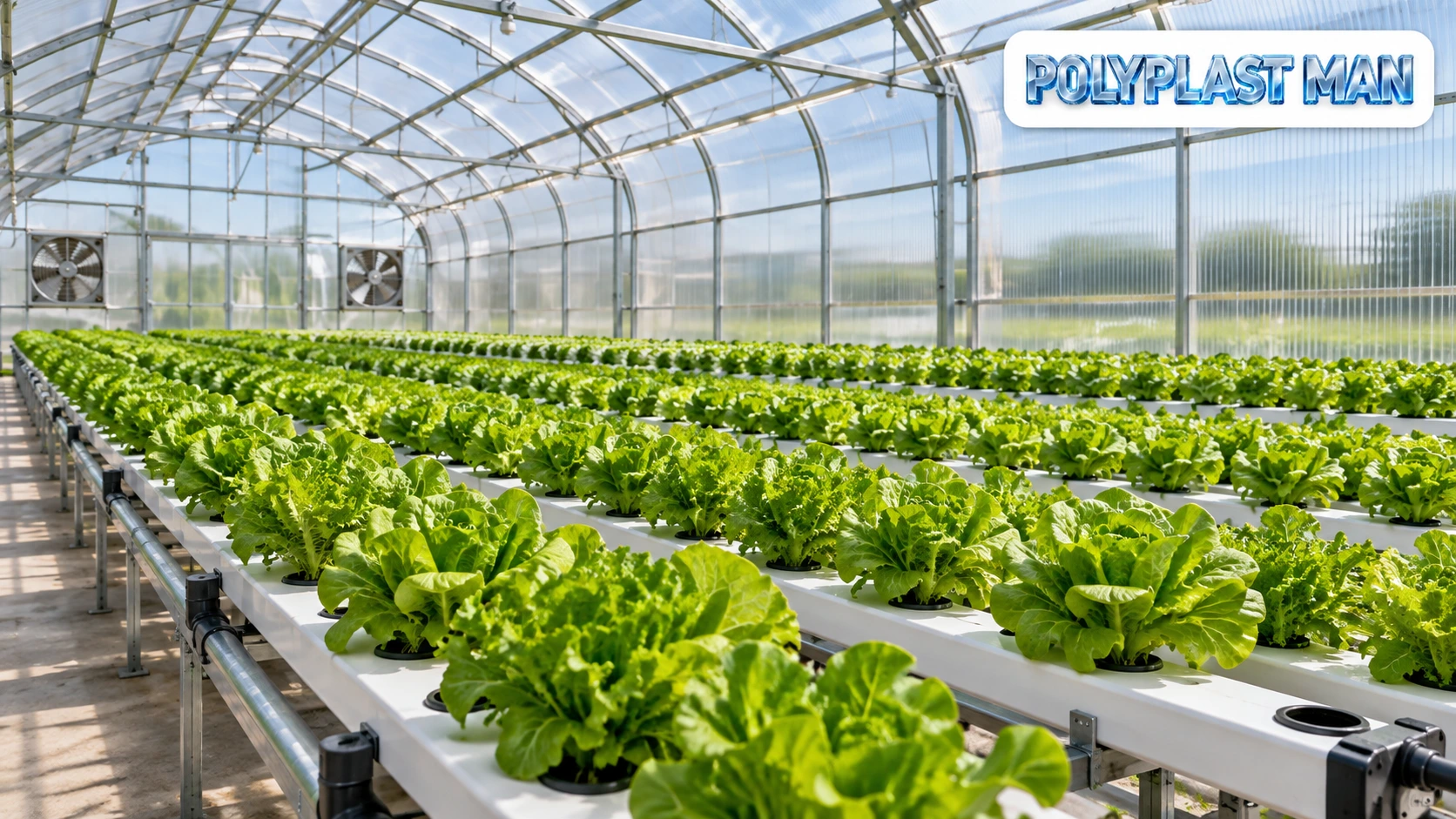
Hydroponic facilities: the growing method does not automatically dictate the glazing. A hydroponic crop still has light and temperature requirements, while equipment layout can affect access and maintenance.
Research and teaching: documented specifications, repeatable environmental conditions and maintainable compartments may be priorities. Keep records of panel grade and replacement history so future changes can be evaluated.
Garden greenhouses: straightforward ventilation, safe access and available replacement parts may matter more than elaborate controls. A modest structure still needs suitable anchorage and glazing retention.
For wider material context, see Polyplast Man’s coverage of polycarbonate applications and multiwall roofing and daylighting.
Installation details that deserve attention
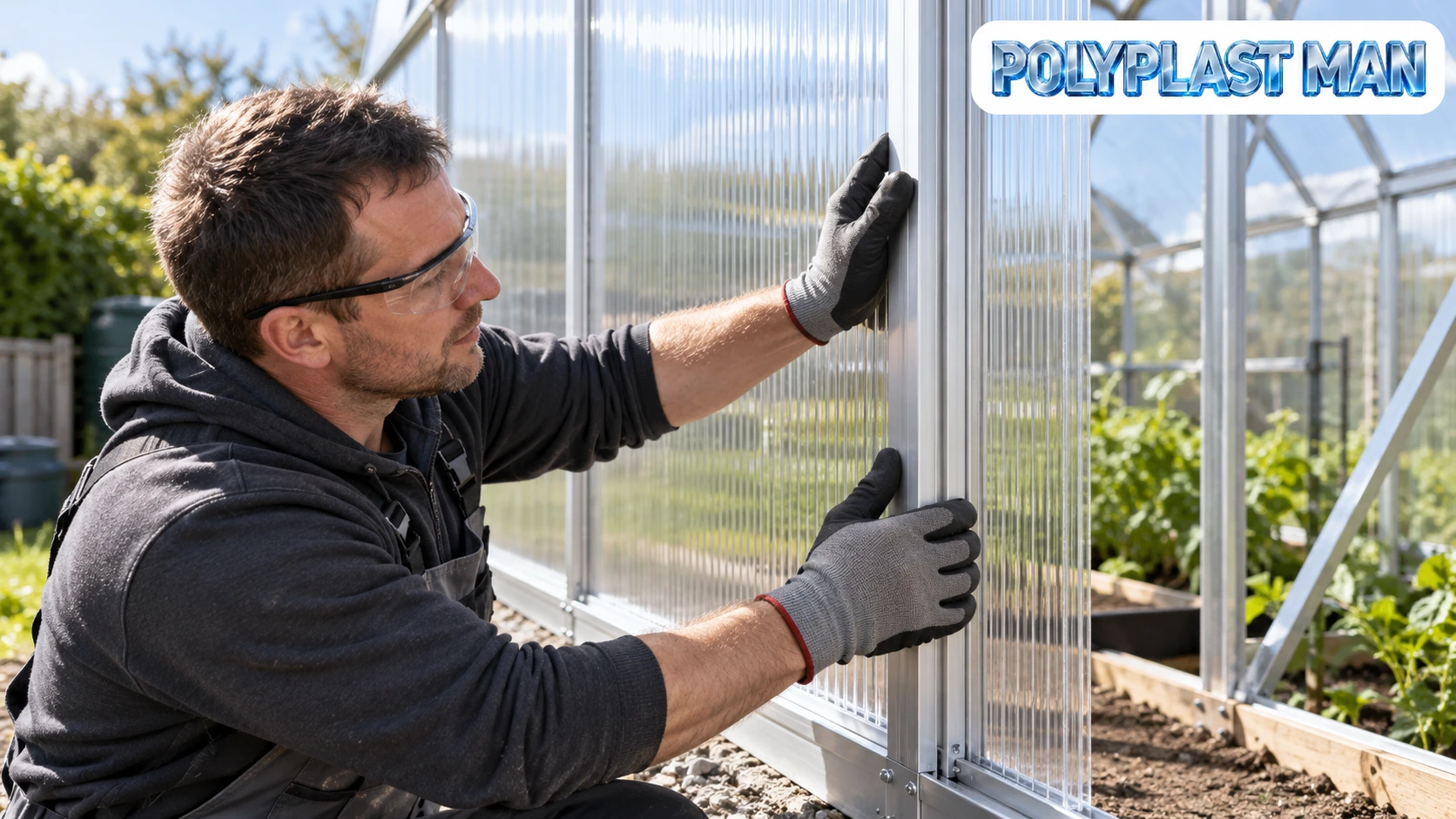
Always follow the manufacturer’s installation guidelines and applicable structural requirements. The following points are a design review checklist, not a substitute for the selected system’s instructions.
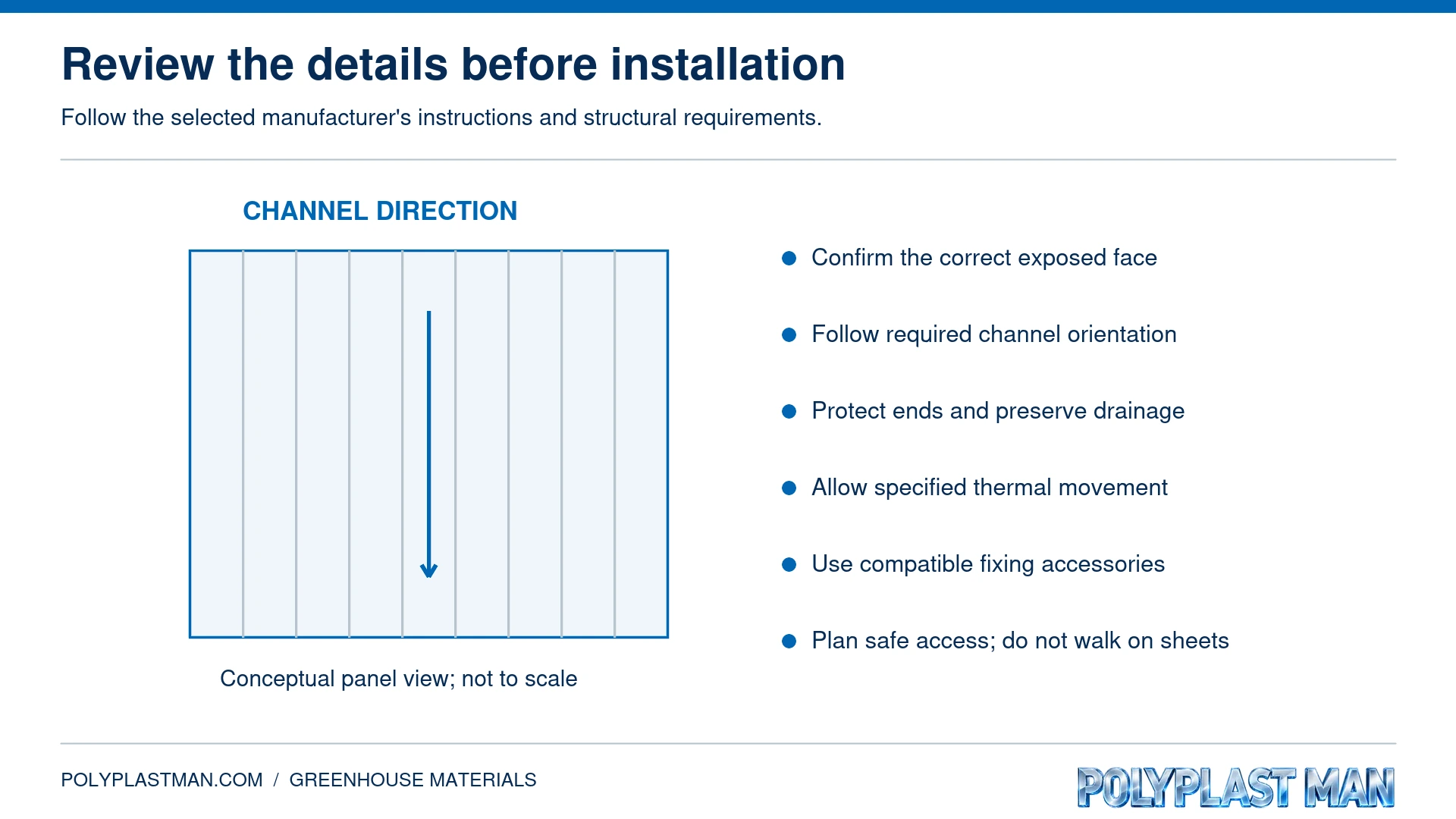
Verify measurements against the actual frame, including diagonals and openings. Record the approved sheet orientation before protective markings are removed. Chamber direction, surface treatment and roof geometry must be coordinated, not considered separately.
Allow for thermal movement using the supplier’s prescribed details. Incorrect restraint can put stress into a sheet as temperatures change. Fixing holes, washers, profiles and edge engagement are system-dependent; generic dimensions copied from another brand’s guide should not be substituted.
Channel ends and drainage deserve a separate inspection. Suitable closure details help limit contamination while allowing the intended moisture management. Confirm the compatible sealants and accessories rather than assuming a general construction adhesive is suitable.
Plan safe access for both installation and later cleaning. Do not treat greenhouse glazing as a walking surface. Before installation, obtain the selected panel manufacturer’s current instructions and confirm the requirements for sheet orientation, thermal movement, edge protection and safe maintenance access.
At handover, retain labels, invoices, drawings and photographs of concealed details. These records help a future contractor source compatible replacements and make any warranty enquiry more precise.
Cleaning, inspection and planned maintenance
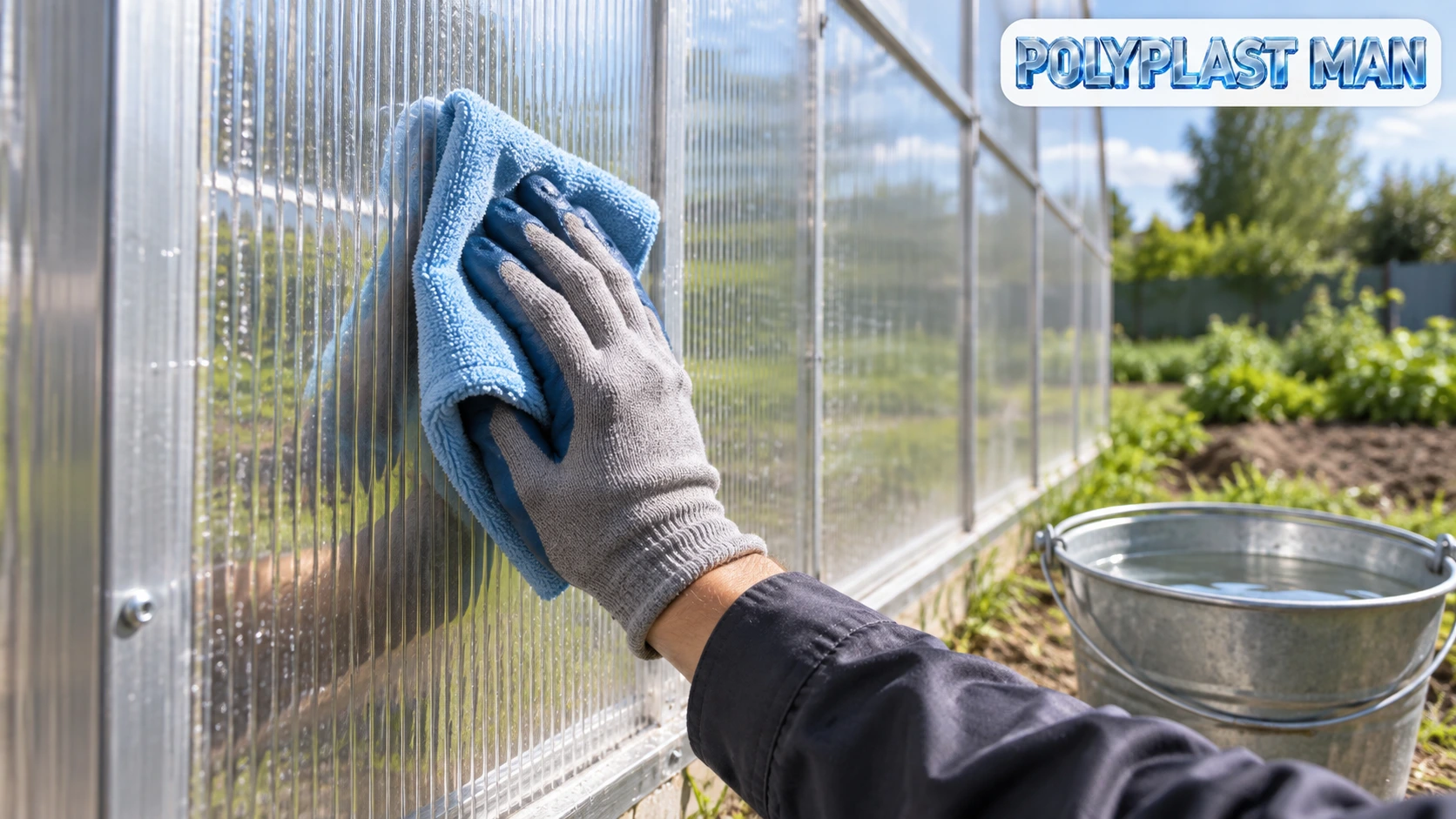
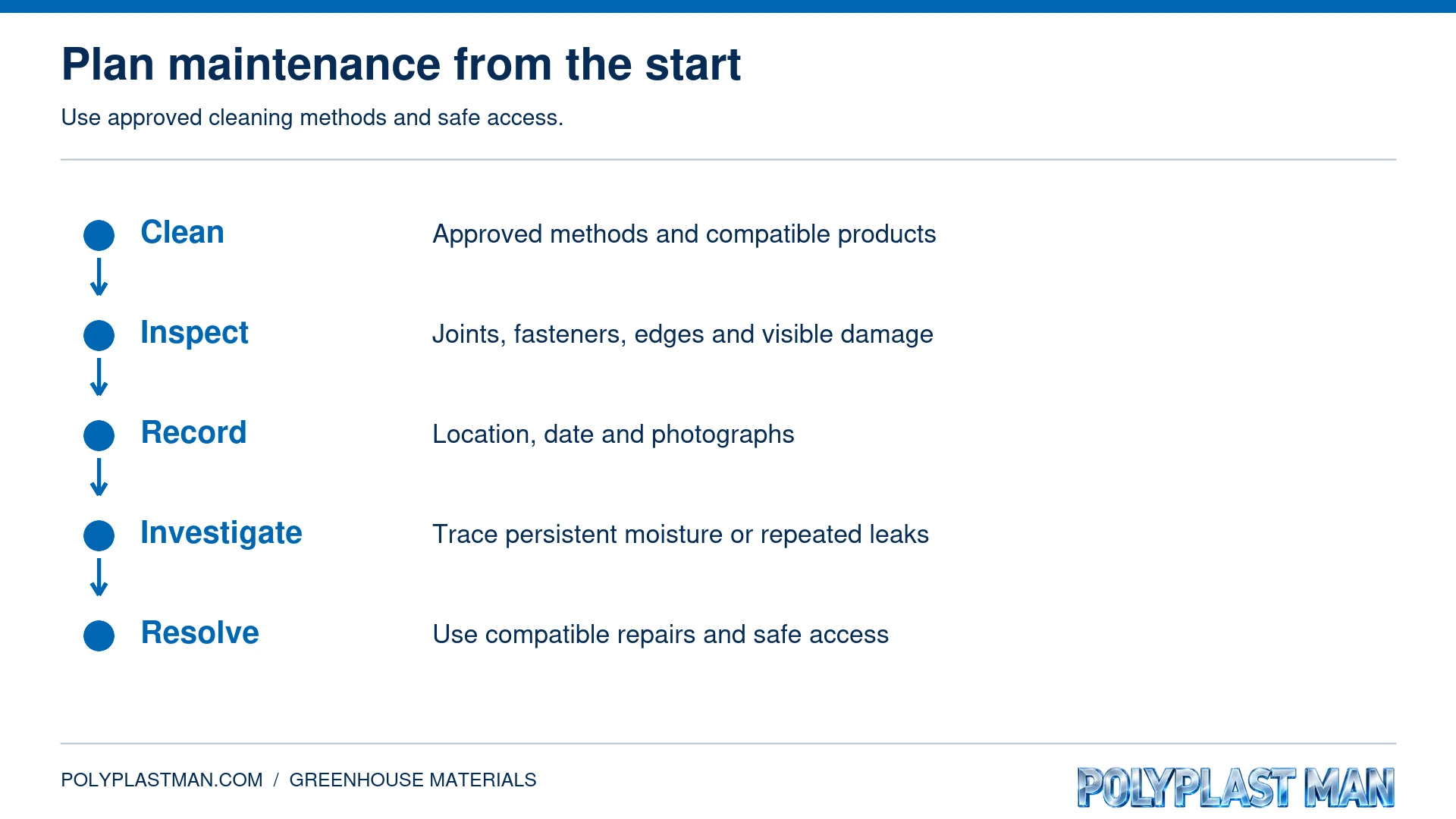
Follow the panel manufacturer’s cleaning instructions, including any requirements for coated surfaces. Remove loose dirt gently and use approved cleaning materials. Avoid abrasive pads, dry scraping and unapproved solvents; an apparently effective cleaner can be unsuitable for the glazing.
Set the cleaning schedule according to conditions rather than a universal calendar. Dust, nearby vegetation and site activity affect how quickly deposits accumulate. If crop light availability is a concern, investigate glazing cleanliness alongside shading and seasonal sunlight.
Inspect accessible joints, fasteners, gutters and channel closures. Look for movement, damaged seals, displaced profiles, persistent moisture and visible damage. A repeated leak should be traced to its cause instead of repeatedly covered with more sealant.
Keep a simple maintenance log with dates, locations and photographs. This is particularly useful on a large greenhouse where similar-looking bays can make faults difficult to track. Arrange roof access through a suitable safe working method.
Common purchasing mistakes
- Comparing only price per sheet: compare usable area and the complete installed system.
- Ignoring the operating climate: assess hot-weather control as well as cold-weather heat loss.
- Choosing by appearance: check crop-relevant light information.
- Treating thickness as a quality score: compare structure and documented performance.
- Assuming every sheet is UV protected: obtain written confirmation for the exact grade.
- Leaving installation to improvisation: agree the joint and fixing system before purchase.
- Mixing incompatible accessories: require approved sealants, washers and profiles.
- Forgetting future access: budget for cleaning, inspections and replacement work.
A useful purchasing discipline is to ask for one complete sample assembly, including a joint and an edge, before a large order. Its purpose is to clarify fit and workmanship expectations, not to replace structural testing.
Budget for the enclosure, not just the sheet
The initial quotation should separate glazing, accessories, supporting work, installation and delivery. Ask whether cutting, wastage, unloading and access equipment are included. A low panel price can be misleading if the missing items are essential to the proposed system.
For ongoing costs, identify the tasks the operator will actually need to fund: cleaning, inspection, seal or accessory replacement and eventual reglazing. Do not insert assumed savings into the business case merely because a brochure describes a panel as energy efficient.
Ask the contractor how a damaged panel would be replaced while nearby bays remain in use. For a working nursery, access and disruption can matter as much as the replacement sheet’s price. Record the supplier’s ability to provide matching components, without treating present availability as a guarantee of future stock.
Is polycarbonate glazing a sustainable choice?
There is no responsible yes-or-no answer based only on the material name. A meaningful assessment considers production, transport, installed quantities, maintenance, operating energy and end-of-life arrangements. Compare alternatives that deliver the same greenhouse function.
Potential material or operational advantages need evidence. A lighter enclosure may change transport or support requirements, but that does not establish a project’s total carbon footprint. Likewise, improved insulation should be evaluated against the actual climate and heating strategy.
Ask for product-specific environmental documentation where available and check its scope. For recycling, contact a local processor about the exact material, contamination limits and collection arrangements. Technical recyclability is not the same as having an accessible recycling route.
Practical steps include an efficient cutting schedule, protected storage and repairable detailing. Keeping usable panels in service is a sensible maintenance goal; it should not become an unsupported claim of unlimited lifespan.
What a credible supplier should provide
Look for a clearly identified grade, dimensional tolerances, relevant test information and installation guidance. Documents should describe the offered product, rather than a different sheet from the same company. Ask how deliveries can be traced to the purchase specification.
Read warranty exclusions before ordering. Understand whether the terms concern impact, weathering, light transmission or another property, and whether labour is covered. Keep the distinction between a commercial warranty and expected operating life clear.
Quality also includes the ability to answer practical questions. A supplier who can explain a limitation, identify a compatible accessory or refer a structural issue to the designer is giving the buyer useful information.
Exploring polycarbonate sheet solutions
For readers researching suppliers, V-LITE® Polycarbonate Sheets is a resource to explore alongside other manufacturers’ technical literature. Request the current data for any proposed greenhouse grade and confirm its suitability with the project team. This reference is not a performance comparison or an endorsement of an unverified specification.
A short review before the order is released
Bring the grower, designer and installer into the same review. The grower can confirm the operating brief, the designer can resolve structural and environmental questions, and the installer can identify details that affect execution. Unanswered questions should remain visible rather than disappear into a general product description.
Use a comparison sheet with a column for each offer and a separate column for missing information. Record the date and revision of every technical document. If a supplier changes the proposed grade after quotation, repeat the relevant checks; a substitution should not be accepted solely because the nominal thickness remains unchanged.
Also agree how the completed work will be inspected. Useful handover checks include product identification, visible fixing condition, closure details, operation of vents and access to maintenance information. These are purchasing and documentation steps, not a substitute for the contractor’s quality procedures or the engineer’s approval.
A well-defined order makes responsibility clearer. It should be possible to identify who supplied the sheet, who selected the fixing arrangement and who confirmed the frame’s suitability. That clarity is valuable if the greenhouse later needs an extension or a change of crop.
Frequently asked questions about polycarbonate greenhouse panels
What are polycarbonate greenhouse panels?
They are thermoplastic sheets used for greenhouse roofs and walls. Products include solid, corrugated and chambered constructions such as twinwall and other multiwall panels. Their job is to admit suitable daylight and enclose the growing space. The complete system also includes supports, connections, drainage and ventilation details; the sheet alone does not define the greenhouse’s performance.
Are polycarbonate panels suitable for greenhouses?
They can be, provided the chosen grade and installed system meet the project requirements. Check optical properties, outdoor exposure protection, structural compatibility and thermal performance. The crop and operating season should guide the decision. A sheet sold for a general canopy should not automatically be assumed to suit commercial crop production.
Which type is used for greenhouse construction?
Twinwall and other multiwall constructions are options where chambered glazing is useful. Corrugated and solid sheets can also have appropriate applications. There is no single format for every greenhouse. Ask suppliers to explain why their proposed construction suits the particular roof, wall, crop and environmental requirements rather than choosing from the format name alone.
Are multiwall panels a good option for agriculture?
Multiwall panels are worth evaluating where insulation and a relatively light enclosure are priorities. Their suitability also depends on light transmission, support requirements and installation details. Compare the exact products, including any anti-condensation treatment. A more elaborate internal structure is not automatically an agricultural advantage if it conflicts with the crop’s light needs.
How long do polycarbonate greenhouse panels last?
Service life varies with grade, exposure, installation and maintenance. A universal number would hide those differences. Ask for the current written warranty and supporting weathering information, then review its limits. Damage, unsuitable cleaning chemicals or incorrect installation may affect performance before the end of an advertised warranty period. Plan inspections rather than relying on a date alone.
Are all panels UV resistant?
Do not assume so. Specify an outdoor grade with documented UV protection and confirm which side must face the sun. Some products have different treatments on their two faces. The phrase UV protection also needs context: resistance to outdoor weathering is not the same specification as the ultraviolet transmission reaching plants inside the greenhouse.
Do the panels provide insulation?
Chambered constructions can reduce heat transfer compared with single-layer glazing, but the exact performance varies by product. Compare declared U-values on a consistent basis. Whole-greenhouse heat loss also depends on joints, ventilation openings, doors and other surfaces. Insulation should be assessed as part of the environmental design, not as a guaranteed heating-cost saving.
Are they better than glass?
There is no universal winner. Polycarbonate offers useful toughness and relatively low weight, while glass systems can suit other optical, maintenance and design priorities. Compare the actual glazing assemblies and their supporting frames. The most suitable option depends on crop requirements, climate, capital cost, operating strategy and how maintenance will be carried out.
What thickness should a greenhouse use?
The correct thickness must be selected with panel construction, support spacing, local loads, light requirements and thermal targets. It cannot be chosen responsibly from greenhouse floor area alone. Obtain the manufacturer’s data for the exact grade and ask the designer to verify the proposed use. Avoid transferring a thickness recommendation from an unrelated structure.
Can these panels be used for commercial cultivation?
Yes, suitable products can be considered for commercial growing structures. The project still needs an integrated design covering ventilation, environmental control, structural loads and crop management. Obtain documentation for the proposed system and agree maintenance access. A successful commercial specification connects the enclosure to the growing operation instead of treating the roof as an isolated purchase.
How should greenhouse sheets be cleaned?
Use the manufacturer’s approved method and suitable access equipment. Remove dirt gently and avoid abrasive materials or chemicals not confirmed as compatible with the panel and its coatings. Check any special instructions for anti-condensation surfaces. Cleaning frequency should respond to actual site conditions. Do not walk directly on the glazing to reach a dirty area.
What should I request before placing an order?
Ask for the exact grade, dimensions, optical and thermal data, relevant load information, surface-treatment details, installation instructions and warranty. Request a complete accessory list and a clearly defined installation scope. Confirm delivery, handling and replacement arrangements. Keep these documents with the project records so that later maintenance and replacement decisions use the original specification.
Choose the panel as part of the growing system
Polycarbonate greenhouse panels offer several useful routes to a durable, daylight-admitting enclosure, but the material name is only the beginning of the specification. Twinwall and other multiwall sheets, solid panels and corrugated products serve different design needs. Their strengths become useful when matched to the crop and the building.
The soundest selection starts with operating requirements, then checks light, thermal performance, local exposure and structural compatibility. Installation details and maintenance access deserve the same attention as the sheet itself. A convincing quotation explains these connections and identifies its limitations.
For farmers and nursery operators, the aim is a greenhouse that can be managed reliably. For architects, contractors and project managers, it is a documented system that can be installed, inspected and maintained as intended. Neither goal is served by unsupported lifespan claims or a universal thickness recommendation.
Keep the technical documents, review the complete installed cost and ask specific questions before purchase. Explore more polycarbonate technologies, roofing applications and building materials on PolyplastMan.com.